250K
14M
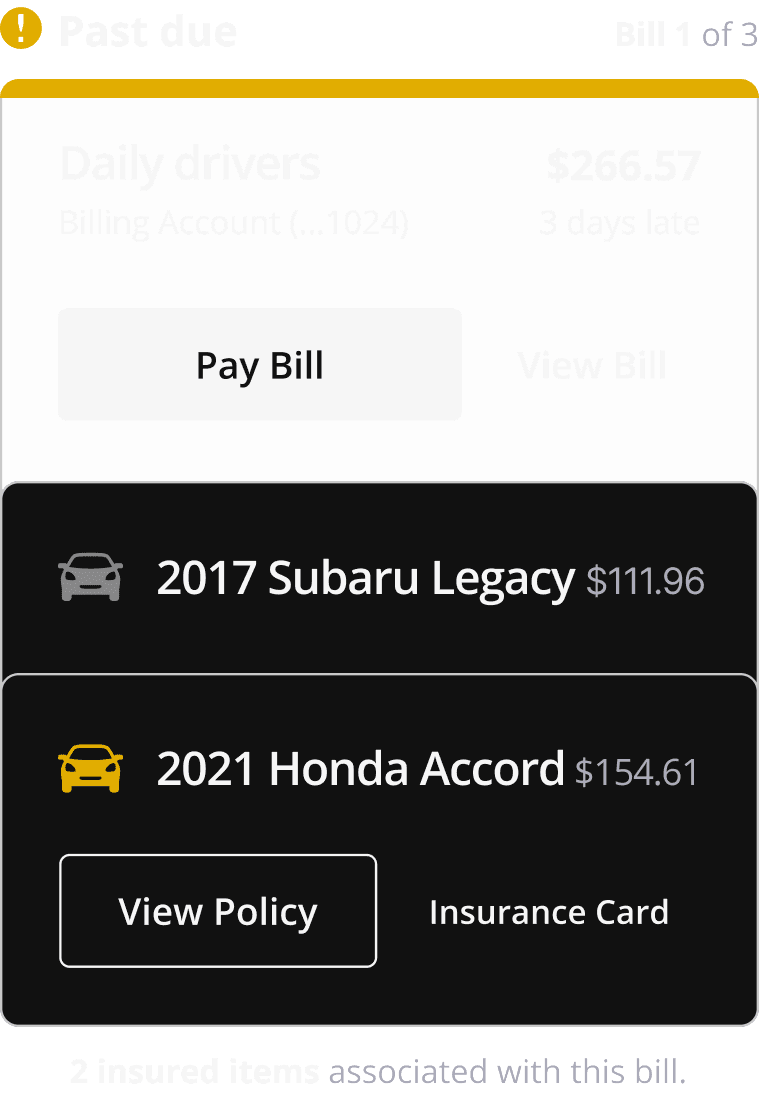
New front door. Combined billing status and active policies into one scannable surface. Everything a customer needs to understand what they owe, why, and what to do next … before having a reason to call.
Average customer holds 2.7 policies. The system surfaces all of them.
David Anfield › Senior Product Manager › American Family Insurance
Directed the design strategy for their internal product recommendation system, designed to work across vastly different users … different permission levels, seniority, experience, and operating models.
Required understanding the full AmFam product catalog across compliance, regulation, and liability boundaries. The domain knowledge the work demanded was significant.
This upsell and cross-sell system started as a narrow internal tool generating modest returns. I led its expansion by leveraging AI decisioning that evaluated each customer in real time ... their active products, location, account status, payment behavior, and eligibility … and directed how offer categories were prioritized and surfaced across customer segments. No generic offers. Recommendations grounded in the individual.
The experience shifted from "sell something else" to "act like a trusted advisor." Billing calls became value moments. I redesigned the system by permission level so unlicensed reps stayed compliant while licensed agents got the full recommendation set. Reps stopped deflecting and started closing.
The signal was immediate. Revenue didn't grow. It multiplied.
Ben Grams › Independent Agent Owner and SME › American Family Insurance
2nd Largest
7
Re-work Dropped
Errors Flagged
Directed a seven-person engineering team, 3D canvas developer, and illustrator while leading UX research across seven production sites and redesigning the configurator.
Millions of possible configurations across ten cabinet box types, each with unlimited customization variables.
Decore operates in a category where uncertainty is expensive and mistakes cascade into rework, delays, and lost trust. The challenge wasn't visuals ... it was translating a nightmare of variables into clarity. I led the design of a dynamic kitchen builder that made complex cabinet decisions feel obvious, aligning production constraints and contractor needs into a single system so customers could see exactly what they were buying before committing real money.
Confidence went up. Errors went down. Second-guessing dropped.
Under the hood, configurations render in real time, orders auto-split by factory capability, and issues flag before production. Extreme customization without requiring expertise, across seven production sites. Margin protected.

Measure twice, ship once →
99.9%
50%+
Directed a distributed engineering team to replace the analog process with a single real-time enrollment platform.
Historic NYC cooking school running enrollment through binders, phone calls, and file cabinets.
I didn't just design the system. I found the problem first. I enrolled at the school, saw the operational drag firsthand, and pitched a better way directly to the founder. She backed it and brought it to the board with me. Once approved, I assembled and led a small distributed team across multiple cities and built the school's operational heartbeat from scratch.
Real-time enrollment, automated waitlists, instant confirmations, high-availability scheduling. The platform became something the school depended on daily, not a side tool.
The system launched over a weekend. By Monday it was already running without staff intervention. The board had panicked at launch. The system proved them wrong before Tuesday.
John Lennon and Yoko Ono once studied here. It was later acquired by Le Cordon Bleu. The system I led modernized a historic institution without breaking what made it special.
I enrolled to find the problem →
22
Yahoo!
Led a cross-functional team at COW as Creative Director, hired by Imagine Television and JJ Abrams to deliver a full-season narrative experience Disney said couldn't exist.
Imagine Television hired COW. Disney controlled the IP and held the purse strings.
I'm sitting in a massive Disney conference room surrounded by lawyers and execs from Buena Vista Interactive and Imagine Television. Cage-match energy. Disney wants the Felicity site done in-house. Imagine hired COW and isn't backing down. Someone asks what happens if we fire these guys. Imagine answers instantly ... we'd immediately rehire them. The room goes quiet. Now the pressure is on me.
Disney pushes back hard. Contracts cap usage at four minutes of footage across the entire season. Not enough to cover 22 episodes. I took the constraint back to my team and did the math. Four minutes at 30fps is 6,000 frames. I reframed the site as a narrative system, rebuilding every episode into storyboard-driven story moments. The full season landed in 4,000 frames, leaving room for targeted clips where they actually mattered.
I fought for the viewer over corporate convenience. Imagine backed the call. We shipped the first TV show website that wasn't an afterthought ... paid for by Disney, embraced by fans, recognized as a defining moment for the medium.
22 episodes in four minutes →
250K
Led a cross-functional team at COW as Creative Director to deliver the first ever interactive standard character guide for Mickey, Minnie, Donald, Daisy, Goofy, and Pluto, transforming the printed Standard Character Guide into a living interactive system Disney licensed as their official digital style guide.
Disney Consumer Products. 142 core characters. The most protected IP in entertainment.
Less than a year earlier my team built the first of five projects for Disney ... an internal character system organizing 142 characters by their relationships, friends, and rivals. They'd seen the Mercedes launch and said something that stuck ... you put 110 years of history into context. Now they wanted the same treatment for their most guarded asset.
The night before the meeting I'm thinking about how to close this. Disney doesn't adopt interfaces designed for other companies. Disney definitely doesn't follow someone else's lead.
Then it hits me ... bring my Dalmatian, Jasper. This is Disney.
By the end of the meeting the VP of Disney is on the floor with the dog. They license the Mercedes UI on the spot. What was an $800 printed book becomes a living interactive product that costs a few dollars to reproduce and can evolve instead of reprint.
Mercedes paid $250K to design it. Disney licensed it for the same budget. Design stopped being a deliverable and started behaving like an asset.
Today we'd call it reusable components. Back then we just called it good design.
8
Licensed
Led a $250K ground-up product launch for Mercedes-Benz, traveling to Stuttgart and directing a cross-functional team to invent and deliver a time-released narrative CD-ROM experience via The Designory.
Direct-mail CD-ROM launch for the next-generation E-Class ... 110 years in the making.
Fresh office in Santa Monica, same building as Frank Gehry. We mailed out an experimental CD-ROM showing what timed narrative interaction could do. When The Designory received it, they called immediately. Their client was Mercedes-Benz. Could we do this for a car launch?
The Designory gave us the line ... the next-generation E-Class. 110 years in the making. I took it back to my team and made a critical call. The history would be the UI. No main menu. Just full immersion.
A five-day unlock revealed each chapter of Mercedes innovation ... inventions, racing, prototypes ... while the new E-Class slowly emerged beneath. As moments were explored they disappeared, revealing what came next. On launch day the full vehicle unlocked in sync with dealerships worldwide.
Stakeholders asked where the menu was. I stood my ground. There is no menu.
The experience landed ... eight major design awards, featured across the industry, and later licensed by Disney as the foundation for their first interactive Standard Character Guide.
There is no menu →
$4M
25
25
Top
Founder and co-creative director. Built and led a 25-person interdisciplinary team while owning vision, hiring, clients, revenue, and creative direction.
National creative firm operating at brand scale during the earliest commercial years of the web.
Santa Monica, California. 1994. Interactive was just starting to get real and most people didn't know what to do with it yet. I founded COW with a simple aggressive idea: interactive deserved design leadership.
We opened in the Frank Gehry building because that's where this kind of work belonged. Experimental by nature, disciplined by execution. Under my direction COW scaled to more than 25 designers and technologists.
No standards. No vocabulary. No proof interactive could drive revenue. Every engagement meant educating executives while inventing the process and shipping at risk. We took unfamiliar technology, stripped away the noise, and shipped experiences that made sense to real people ... before best practices existed.
Mercedes-Benz, Disney, Nike, Motorola, Pioneer, Tetra Pak, Intel, Boeing. Clients kept coming because we kept delivering. 25 awards. $4M in four years. Conference stages. Magazine covers. Teaching at Otis.
This was the seed. Landing clients, leading people, delivering when it counted.
We made the rules →
$500K
9
Student-led initiative. Assembled and directed a multi-disciplinary team to build and pitch the ArtCenter Narrative Catalog, an unsanctioned interactive platform, to the institution's president.
Global design institution positioning itself to lead the future of multimedia.
Pasadena, California. Early 90s. ArtCenter was positioning itself as the leading place to study new media. Campuses in Switzerland. Another in Kyoto. Big ambition. Big words. But interactive wasn't part of the curriculum yet.
So we decided to prove it.
I pulled together designers, photographers, and product designers with a clear point of view: interactive wasn't something you talked about ... it was something you built. This wasn't a class assignment. It wasn't sanctioned coursework. It was conviction.
We pitched ArtCenter's president, David Brown. What we didn't know was that he'd been invited to speak in Kyoto within six months, tied to the city's 100-year vision of becoming the multimedia capital of the world. He immediately understood this project would write that speech for him.
Under my direction we were given 24-hour access, an office on the corporate bridge, and carte blanche to every resource the school had. We built fast. We shipped. We raised $500K from LACMA and Silicon Graphics. The work won the first Gold Clio ever awarded for Interactive Media.
This was the inception. The spark. The raw beginning of everything that followed.
Teaching the school →